

On 1 September, 2026, the National Research Council of Thailand (NRCT), of the Ministry of Higher Education, Science, Research and Innovation, organised a seminar entitled “Preparing, Understanding, and Responding to Natural Disasters through Research and Innovation”, bringing together knowledge, technology, and innovations to prepare for and respond to disaster situations. Dr Wiparat Dee-ong, Director of the National Research Council, chaired the opening remarks and presented research and innovation initiatives for disaster response. The event was attended by experts, researchers, executives, participants, and members of the media, and was held at the Center for Research Promotion for Cultural Heritage, National Research Council of Thailand.
Dr Wiparat stated that past natural disasters, both in Thailand and abroad, such as flash floods and landslides in many areas, the rapid collapse of glaciers in the Himalayas, and earthquakes in various global regions, reflect the fact that natural disasters can occur without prior warning and affect people’s lives and property. Therefore, it is essential for the public to be knowledgeable about disasters, and possess understanding, skills, and preparedness to cope with natural disasters in order to reduce risks and losses of life and property.
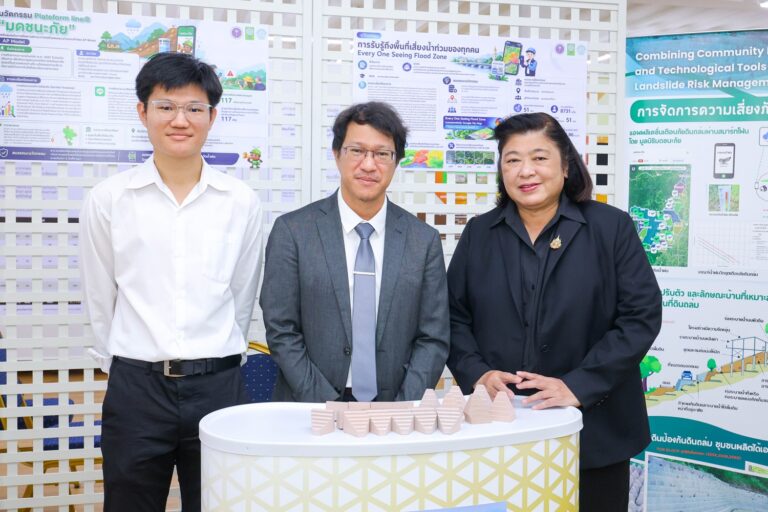
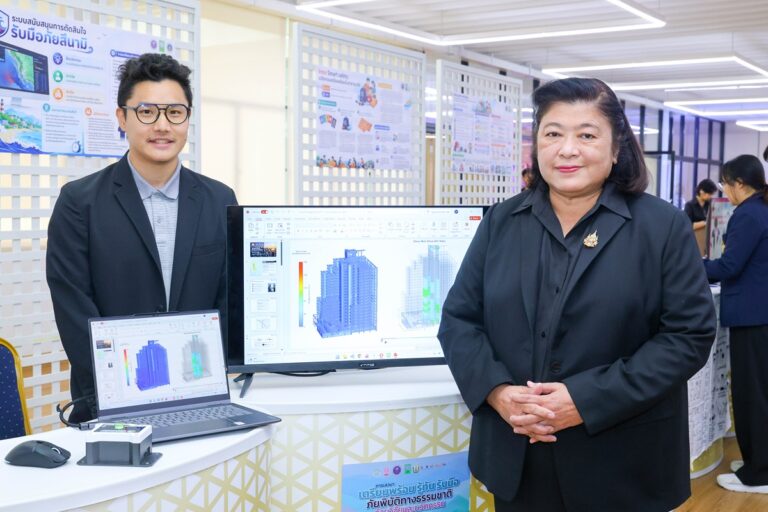
The National Research Council of Thailand (NRCT) aims to communicate knowledge to build understanding, as well as showcase research and innovation projects for preparedness in natural disasters. These projects, funded by the NRCT, serve as a crucial mechanism towards enhancing the readiness of agencies and the public to systematically and effectively respond to disaster situations. Today, a total of 12 research projects are on display, including two by Kasetsart University’s experts on geotechnical and structural engineering from our Faculty of Engineering:
- Associate Professor Dr Sutthisak Soralump, an expert on geotechnical engineering from Kasetsart University’s Department of Civil Engineering, presented on the topic “Prevention Before Collapse: A Monitoring Mechanism for Landslides during the Rainy Season”, citing the example of a rapid landslide in the Himalayas-Nepal/Tibet region. He hypothesized that global warming caused the active layer’s freezing and thawing cycles to become more frequent, deteriorating the permafrost, which forms the base of the ice sheet. The risk increases with steeper mountain slopes. Nepal, with its existing natural lakes formed by landslides and rockfalls necessitating well-deigned drainage systems to prevent further collapse, was further stimulated to prevent more severe landslides. He explained that managing landslides in high-risk areas with land use at the base of hills involves utilizing research and innovation for risk assessment and early warning systems, developing community processes and individual adaptation, raising risk awareness, and implementing scientifically-based projects, including incorporating landslide risks into construction standards.
- Professor Dr Amorn Pimanmas of Kasetsart University gave a presentation on the topic “How Should We Prepare Our Cities and People for a Future When Earthquakes Are No Longer a Distant Concern?” He analyzed the causes of building collapses due to earthquakes and disseminated information on the application of research and innovation in real-time structural vibration monitoring and earthquake warning systems. This included a network of sensors distributed throughout each building to measure vibrations and assess structural damage, as well as a warning system for building occupants, along with examples of building reinforcement.
News story in Thai national media: https://www.khaosod.co.th/technologychaoban/techno-news/article_345067
